Industrial Automation Systems: The Architecture of the Modern Factory
From relay logic to smart manufacturing — how automation became the backbone of global industry, and why understanding its fundamentals is no longer optional.
Industrial Technology12 min read
The factory floor has always been a theatre of transformation. Raw materials enter, finished goods leave, and somewhere in between, human ingenuity bridges the gap. But over the past century, that gap has been increasingly filled not by hands and muscle, but by machines that think — or at least, machines that follow instructions with extraordinary precision and tireless consistency. This is the promise and the reality of Industrial Automation Systems (IAS).
At its core, an industrial automation system is an integrated collection of hardware, software, sensors, actuators, and control logic designed to monitor, control, and optimize industrial processes with minimal human intervention. The scope of these systems ranges from a single robotic arm on an assembly line to entire “lights-out” facilities that operate around the clock without a single human operator on the floor.
The Building Blocks of Automation
Every industrial automation system — regardless of industry, scale, or age — is built around a common set of functional components. Understanding these elements is the foundation of understanding automation itself.
Sensors and Input Devices
Sensors are the nervous system of any automated facility. They continuously gather data from the physical environment — measuring temperature, pressure, flow rate, position, speed, humidity, vibration, and a dozen other variables — and convert these physical quantities into electrical signals that control systems can interpret. Modern industrial sensors have evolved dramatically: today’s devices offer wireless connectivity, self-diagnosis, and microsecond response times that would have seemed fantastical to engineers even thirty years ago.
Controllers: The Brain of the Operation
The data collected by sensors flows into controllers — the decision-making core of any automation system. The Programmable Logic Controller (PLC) has been the workhouse of industrial control since the late 1960s, when the automotive industry demanded a more flexible replacement for relay-based control panels. A PLC continuously scans its inputs, executes a user-defined program, and updates its outputs accordingly — all in a cycle measured in milliseconds. More sophisticated tasks are handled by Distributed Control Systems (DCS), which manage complex, continuous processes like chemical refining or power generation, distributing control functions across a network of nodes rather than centralizing them in a single unit.
“A modern PLC executes thousands of decisions per second — without fatigue, without distraction, and without error.”
Actuators and Output Devices
If sensors are the ears and eyes of an automated system, actuators are its hands. Actuators receive electrical commands from controllers and convert them into physical action: motors rotate, valves open or close, hydraulic cylinders extend or retract, conveyors accelerate or slow. The precision and reliability of modern actuators — stepper motors capable of positioning a component to within microns, proportional valves that regulate flow with extraordinary accuracy — is one of the great unsung achievements of industrial engineering.
Human-Machine Interface (HMI)
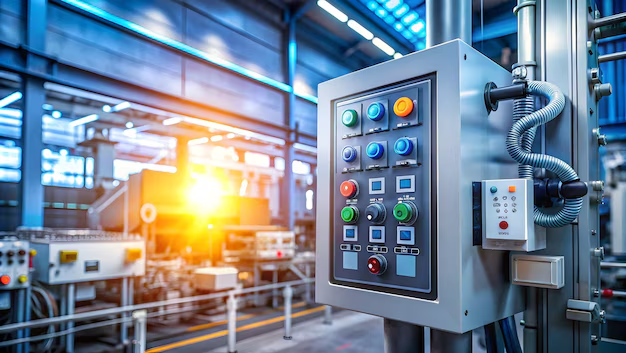
The HMI is the window through which operators observe and interact with automated systems. From the primitive indicator lights and physical switches of early automation to today’s touchscreen dashboards streaming real-time data from hundreds of process variables simultaneously, the HMI has evolved into a critical tool for situational awareness and decision support. A well-designed HMI doesn’t just display data — it filters the noise, highlights anomalies, and guides operators toward the information that matters most.
$395BGlobal IAS Market by 2029
78%Reduction in defect rates reported by early adopters
24/7Operational uptime in fully automated facilities
Levels of Automation: The Automation Pyramid
Industrial automation is commonly organized into a hierarchical model known as the “Automation Pyramid” or “ISA-95 model.” At the base lies the field level — the physical devices that interact directly with the process: sensors, actuators, and drives. Above that sits the control level, where PLCs and DCS units reside. The supervisory level — SCADA systems and HMIs — provides oversight and operator interaction. The manufacturing operations level manages production scheduling, quality, and maintenance. At the apex sits the enterprise level, where ERP systems connect factory operations to business functions like procurement, finance, and logistics.
This hierarchical model, while increasingly challenged by the flat, interconnected architectures of Industrial IoT, remains a useful conceptual framework for understanding how information and control authority flow through an automated facility.
Why Automation? The Fundamental Value Proposition
The case for industrial automation is not merely economic, though the economics are compelling. Automation delivers consistency — a robot performing a welding operation will repeat the same motion to the same specification ten thousand times in a row without variation. It delivers speed — modern automated assembly lines operate at rates no human workforce could match. It delivers safety — removing workers from dangerous, repetitive, or ergonomically harmful tasks dramatically reduces injury rates. And increasingly, it delivers intelligence — systems equipped with machine learning can detect subtle patterns in process data that would be invisible to human observers, predicting equipment failures before they occur and continuously optimizing process parameters for maximum efficiency.
The factories of the twenty-first century are not simply faster or cheaper versions of their predecessors. They are fundamentally different kinds of organizations — information-processing entities as much as physical production facilities, and understanding their operating logic requires understanding the automation systems that animate them.